


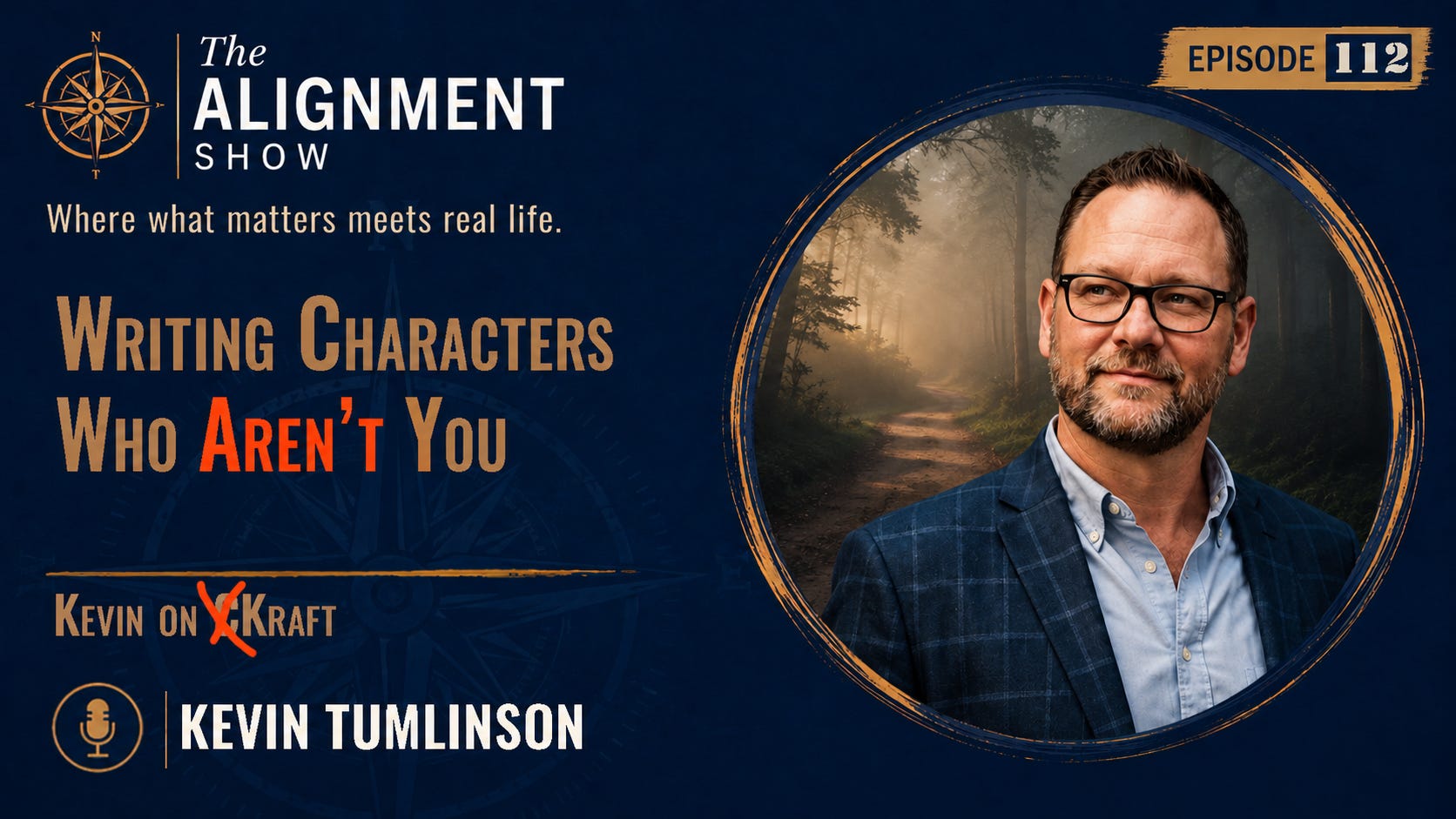
[Note: this post contains the podcast and its show notes along with the article version. Enjoy whichever one connects with you best. If you’re listening on a podcatcher and want the article version, head over to DonnKing.com/112.]
One of the things I enjoy about talking with Kevin Tumlinson is that I can start with a question I think I understand and discover that I was actually asking something bigger.
That happened again in this third installment of Kevin on Kraft.
“Kevin on Kraft?” you ask. If you don’t know about it, here are the first two episodes in this special series on The Alignment Show.
Last time, Kevin made an almost offhand comment that some of his characters are smarter than he is. That stuck with me. Because how exactly do you write a mind you don’t possess? You can research what a physicist knows, for instance, but knowing facts and thinking like that person aren’t quite the same thing.
From there, we wandered into something broader: writing people who aren’t like us. Different backgrounds. Different genders. Different experiences. Even people whose choices we find reprehensible.
And eventually we landed on what may be the real question underneath all of it: What makes a character feel like a human being rather than something the author constructed?
As usual, Kevin and I found a few side roads along the way. We talked about villains, Thanos, Batman, Jack Reacher, Star Trek, watery tuna salad, and why a writer might want access to a time machine.
You know. Craft.
Big Takeaway
A believable character doesn’t have to be like the writer, but the writer has to understand the character well enough to see the world from inside that character’s logic.
That includes villains. It includes characters whose lives and backgrounds differ radically from our own. And it even includes recurring characters who need to grow without changing so much that readers no longer recognize the person they came back to see.
Perhaps most interestingly, Kevin suggested that character growth doesn’t stop at the edge of the page. Sometimes the person who changes over the course of a story… is the reader.
What We Talked About
How to write someone smarter than you are. Kevin points out that his character Dan Kotler has an advantage Kevin doesn’t: Kevin can stop, research, revise, and return to an earlier scene. The character gets to benefit from the author’s hindsight.
Writing across differences without reducing people to categories. We talk about characters of different races, cultures, and genders, and the danger of trying so hard to portray a category that we stop portraying a person.
Why the craft should disappear. Kevin compares good writing to sculpture: if we’re staring at the chisel marks, we’re not seeing the statue. The same principle applies to voice, characterization, and even book design.
Why villains need an internal logic. People generally don’t experience themselves as “the bad guy,” even the ones we perceive as the bad guy. A compelling antagonist sees reasons for doing what they do. Understanding those reasons doesn’t mean agreeing with them, but it keeps them from being cardboard.
How series characters can change without becoming different characters. Kevin distinguishes between a protagonist who changes and one who serves as a catalyst for change. Jack Reacher, Batman, and the crew of the Enterprise help us explore why some characters need to return largely to baseline while the people and world around them change.
The reader has a character arc, too. Stories don’t simply happen to fictional people. We bring ourselves to them, make meaning from them, and sometimes finish a book seeing something differently than we did when we began.
Practical Tips
When you’re writing someone unlike yourself, start with the person before the category. Research matters, and sometimes talking with people who actually have the experience you’re portraying matters enormously. But research shouldn’t become a substitute for creating an individual human being.
Give yourself permission to make a character smarter than you. Drafting and revision give you something your character doesn’t have: time. Research the answer. Think for three days about the insight your brilliant character produces in three seconds. Then let them have the credit.
For recurring characters, ask what is core and what can change. Relationships, experiences, scars, knowledge, and circumstances can accumulate without replacing the qualities that made readers care about the character in the first place.
When writing an antagonist, try asking not, “Why is this person evil?” but, “Why does this choice make sense from where this person is standing?” You don’t have to approve of the answer. You just need to understand it.
Finally, don’t force the theme too early. Kevin argues that theme often emerges from the story itself. Write honestly enough and you may discover meaning you didn’t consciously put there. Once you see it, you can strengthen it in revision.
Note: we might dig into theme next time.
Quote to Ponder
“Don’t downplay your role in the story. You are a character in this story as well.”
— Kevin Tumlinson
Resources
Kevin Tumlinson / The Wordslinger
Kevin and I share these Kevin on Kraft conversations with both of our audiences. Check out The Wordslinger for Kevin’s ongoing conversations about writing, publishing, and the writing life.
Kevin Tumlinson’s books
Kevin has written soooooo many books. I especially like his Dan Kotler books and his Alex Kane books. He can keep you reading for months.
Ray Bradbury, Zen in the Art of Writing
Kevin mentioned that he’s currently reading Bradbury’s collection of essays on writing and recommends it. Amazon or Bookshop
Paulo Coelho, The Alchemist
Kevin used The Alchemist as an example of a book he can reread and find himself changed by the experience. Amazon or Bookshop
The Chemistry Between Us by Devon Marin
I also mention my new STEM romantic comedy during the conversation. You can find it at DonnKing.com/Devon.
Article Version
Writing People Who Aren’t You
How do you write a character who is smarter than you are?
That question sounds almost like a paradox.
If I’m not capable of thinking at the level my character does, how am I supposed to write what that character thinks?
Kevin Tumlinson has a wonderfully practical answer: cheat.
Not really, of course. But a fictional character has an enormous advantage over a real human being. The character has an author who can travel through time.
Kevin’s Dan Kotler is considerably smarter than Kevin claims to be. Kotler can make connections quickly. He can retrieve obscure information at exactly the moment he needs it. He can reach conclusions that might take the rest of us considerably longer.
But Kotler doesn’t actually have to do any of that in real time.
Kevin can write the scene, discover that something is wrong, research it, think about it, and come back later. He can spend hours figuring out something Kotler appears to figure out in seconds.
The character gets the benefit of the author’s hindsight.
That led us to a related question: What happens when the difference between writer and character isn’t intelligence?
What if the character comes from a different culture? A different racial background? A different gender? A life experience the author has never had?
Research certainly matters. I mentioned a character I’m currently writing who owns a kayaking business. I happen to know someone who owns a kayaking business, so I interviewed her. She also has a Native American background, which gives me another reason to listen rather than assume.
But Kevin made an important distinction. When he writes a character whose background differs from his own, he tries first to write the person.
That sounds obvious until you consider how easily writers can do the opposite.
We can become so concerned with writing “a woman” or “a Black character” or “a scientist” that the category begins doing the work the character should be doing. The result can become stereotype even when the writer was specifically trying to avoid stereotype.
Kevin is particularly cautious about things like dialect for that reason. A little may help establish voice or place. Too much can make the author’s hand painfully visible.
That connected with something we had already stumbled across earlier in the conversation. Good craft tends to disappear.
We had been talking about book layout. When a book is designed well, readers generally don’t stop and admire the typesetting. The design gets out of the way and lets them read.
Kevin suggested that authorial voice can work the same way. If readers are noticing the writer showing off on every page, they may not be noticing the character or the story. He compared it to sculpture. We should see the statue, not the chisel marks.
What about characters we don’t want to identify with?
Villains create an interesting problem because an antagonist who wakes up every morning thinking, “Mwuhahaha! What evil can I accomplish today?” usually isn’t particularly convincing.
People tend to experience themselves as the central character in their own lives/stories. While other people may be evil or stupid, they have reasons for their choices. They justify themselves. They believe what they’re doing makes sense.
That doesn’t make their actions right. It makes them human.
We wound up talking about Thanos from the Marvel movies. His solution to the universe’s problems is monstrous, but the story gives him a rationale for it, including his own background of deprivation. More importantly, it gives that rationale enough internal coherence that an audience can understand how he sees himself.
It doesn’t excuse evil. But understanding why a character believes something is not the same as agreeing with the character.
In fact, that ability to understand without agreeing may be one of fiction’s most useful tricks. A story can temporarily put us behind somebody else’s eyes.
That brought us, eventually, to the person we hadn’t talked much about yet. The reader.
Kevin said something that I think may be the most interesting idea in the whole conversation: when we engage with a story, we become part of it.
Characters may have arcs, but readers can have them, too.
He used The Alchemist as an example. When he rereads it, the fictional character changes over the course of the book, but so does Kevin. He reaches the end with a slightly different perspective than he had when he began. This remains true even though he has read the book multiple times.
Writers constantly encounter readers who find things in our stories that we didn’t consciously put there. A reader tells us how much they appreciated the theme we developed, and we think, I did? (And sometimes we just nod and say, “Yes, yes, I’m glad you noticed that!”)
Kevin thinks writers can get into trouble when we begin with the theme and try to build a story around a lesson we want to teach. That can turn fiction into preaching with characters attached.
Instead, he suggests writing the story and paying attention to the themes that emerge naturally. If something meaningful appears, revision gives us the opportunity to strengthen it.
That brings us right back to that fictional time machine. We write. We discover. We go back. We understand a little more.
Then we lay another piece of track.
And, as it happens, that last image opened another conversation Kevin and I will probably have somewhere down the road. Three episodes in, you probably know how that goes.
I’m Donn King. I write about what it means to live and speak from your values, without sanding off the quirks that make a voice worth hearing. This space is where I reflect, tell stories, and stay connected with readers who value clarity, honesty, and the long work of becoming who we’re meant to be.


